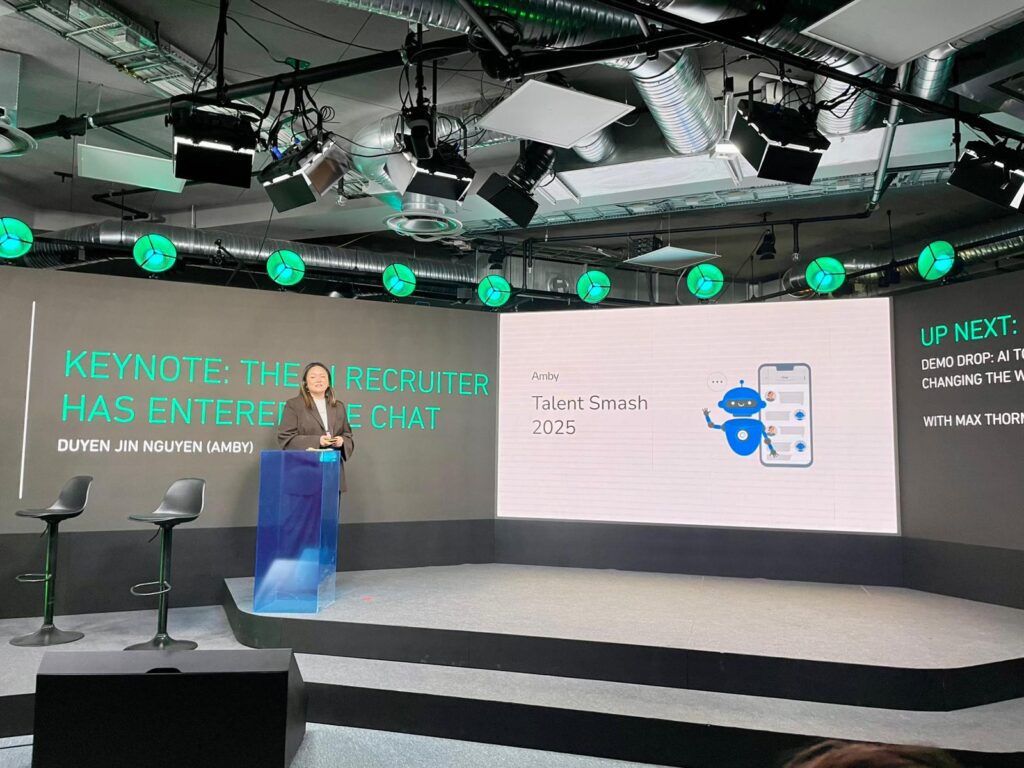
Yesterday, I joined the Epicenter Verge TALENT SMASH event in Stockholm, where the spotlight was firmly on the future of talent, leadership, and the role of Artifical Inteligence(AI) in shaping tomorrow’s workforce.
The fireside chat, led by Matilda Muhr Göransson (Head of Community, Epicenter) with Adrian McDonald (CEO, Epicenter Group) and Henrik Järleskog (Regional Director Europe & Head of Future of Work, Sodexo), sparked a lively and thought-provoking conversation about AI, leadership, and what it means to be a “superworker” in the age of AI agents and virtual teams.
From Months to Hours: AI as a Strategic Partner
Henrik Järleskog shared an eye-opening example: a yearly strategy process that once took his team three months now takes just 4.5 hours with the support of AI agents, cutting down 80% of the workload.
His most creative ideas, he revealed, often come during forest walks, where he records voice notes for his AI assistant. True leadership, he argued, lies in recognising these sparks of inspiration and channelling them effectively.
AI Won’t Replace Jobs — But It Will Reshape Them
The panel agreed that AI isn’t here to take away jobs but to redefine skills and expectations.
Like athletes who dedicate themselves to training, workers must embrace continuous upskilling. Leaders, meanwhile, need to empower their teams to use AI in ways that are not only efficient but also engaging and even fun.
The Beehive Model of Work
A powerful analogy emerged: the beehive. Each bee has a role, yet together they create something extraordinary.
For organisations, the same holds true — we must innovate, create, and distribute solutions rather than stand still. But this evolution may squeeze out middle management. In fact, with AI, one founder could feasibly manage an entire company alongside 10 AI agents working virtually in parallel.
Leadership in the Age of AI
Adrian McDonald underlined the value of shadow projects — testing AI-driven approaches alongside traditional ones to challenge habits and prevent “analysis paralysis.”
In this new landscape, leadership will shift from controlling processes to setting goals, building trust, and letting both humans and AI run with them.
Hybrid, Virtual, or Office-Based?
A question many organisations face is: where should work happen?
AI agents and digital workflows are reshaping the role of physical presence. Offices may increasingly become spaces for connection, creativity, and trust-building, while focused tasks can often be done more effectively from anywhere.
The future workforce model will likely be a blend of human presence and virtual collaboration, tailored to organisational needs and individual working styles.
Reskilling and the Human Touch
One striking statistic stood out: 44% of today’s core skills will need retraining.
Jobs will change — some lost, many created. Agility, self-leadership, and the ability to ask better questions will be essential. But reskilling is not just about tech. It’s also about people: curiosity, networking, and in-person connection will remain timeless skills.
The future of work, the panel suggested, will be hyper-personalised, combining digital efficiency with human warmth.
The Big Question: What Life Do You Want?
The conversation closed with a profound reflection. AI may accelerate efficiency and productivity, but ultimately, it pushes us to ask:
What kind of life do we want to create for ourselves? And what kind of life will we accept as the new normal?
✨ Takeaway: The rise of the AI superworker isn’t about humans being replaced, but about us reshaping how we lead, collaborate, and grow. The challenge — and opportunity — lies in blending the power of AI with the uniquely human skills that make work meaningful.